
10x — Improvement in AI output quality achievable with better prompt structure (Anthropic research)
3 sec — Time to write a mediocre prompt vs 30–60 seconds for a genuinely effective one
$0 — Cost to learn prompt engineering — all best resources are free online in 2025
94% — Of knowledge workers who say specific, context-rich prompts produce dramatically better outputs
#1 — Skill most commonly requested in AI-related job postings in 2025 (LinkedIn data)
Why Most People Get Mediocre Results from AI
The most common AI complaint: ‘I tried it but the answers weren’t very good.’ The most common reason: vague, context-free prompts. ‘Write me a blog post about marketing’ produces generic content. ‘Write a 600-word blog post about email marketing for solo freelancers, covering 3 specific tactics with examples, in a direct and practical tone like James Clear’ produces something genuinely useful.
Prompt engineering is the practice of communicating with AI models in ways that consistently produce high-quality, useful outputs. It’s a skill, not magic — and it’s learnable in a few hours of practice.
The Core Framework: RCTF
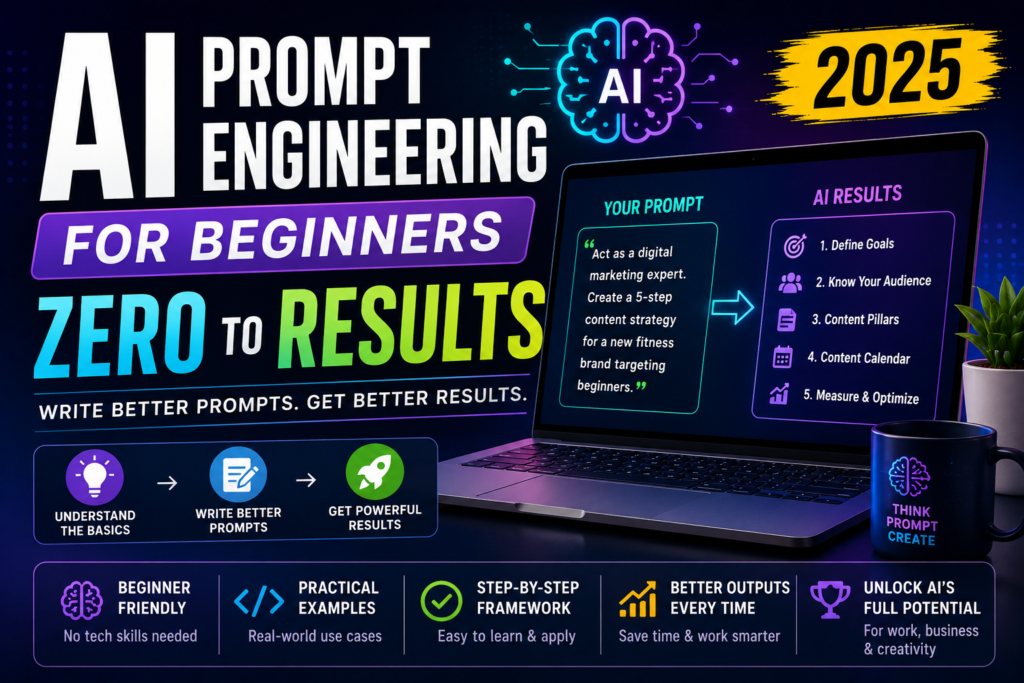
A reliable prompt structure for most tasks: Role (who should the AI be?) + Context (what is the situation?) + Task (what exactly do you need?) + Format (how should the output look?).
5 Specific Techniques That Improve Outputs Dramatically
Technique 1: Add Constraints
Constraints force specificity. Instead of ‘write a summary,’ write ‘summarize in exactly 3 bullet points, each under 20 words, focusing only on action items.’ Constraints prevent AI from defaulting to generic completeness.
Technique 2: Show, Don’t Tell
Providing an example is more effective than describing what you want. ‘Write in this style: [paste a sample paragraph you like]’ produces more accurate tone matching than ‘write in a casual, energetic tone.’
Technique 3: Think Step by Step
For complex reasoning tasks, add ‘think through this step by step before giving your final answer’ or ‘work through the logic before concluding.’ This dramatically improves accuracy on analysis, math, and strategic questions by forcing the model to show its reasoning.
Technique 4: Ask for Multiple Options
When quality matters, generate multiple options and choose the best. ‘Give me 5 different approaches to this problem’ often produces one option that’s significantly better than the first answer you’d have received.
Technique 5: Iterate and Refine
Treat AI conversations as iterative. ‘That’s good but make it 20% more specific’ or ‘rewrite the second paragraph to sound more confident’ are effective follow-up prompts. The best results come from 3–4 rounds of refinement, not the first response.
Real Prompts That Work for Common Tasks
| Task | Effective Prompt Structure |
|---|---|
| Email draft | ‘Draft a [polite/firm/urgent] email to [recipient type] about [situation]. Goal: [desired outcome]. Tone: professional but warm. Under 150 words.’ |
| Document summary | ‘Summarize this document for [audience type] in [X bullet points]. Focus only on [topic]. Highlight any [risks/decisions/action items].’ |
| Problem solving | ‘I’m trying to solve [problem]. Context: [details]. What are 5 distinct approaches, ranging from conservative to creative? List pros and cons of each.’ |
| Learning a topic | ‘Explain [concept] to someone who [knows X level]. Use an analogy to [familiar concept]. Then give me 3 examples from [my field/context].’ |
See also: 10 AI Tools That Save You 10 Hours a Week | How to Use ChatGPT to Land Your Next Job
Frequently Asked Questions
Do I need to learn prompt engineering to use AI tools effectively?
Not formally — but practicing a few basic principles makes an enormous difference. Even knowing the RCTF framework and the ‘think step by step’ technique puts you ahead of 80% of AI users. You don’t need a course; you need 2 hours of deliberate practice applying these techniques to your actual work.
Does prompt engineering work differently for Claude vs ChatGPT?
The core techniques work for both. Claude tends to respond particularly well to detailed context and nuanced instructions. ChatGPT responds well to clear role-setting. Both benefit from constraints, examples, and iterative refinement. The differences are subtle — the fundamentals above apply to every major AI model.
What is a ‘system prompt’ and do I need to use one?
A system prompt is a set of persistent instructions that governs all your interactions in a session or custom AI setup. In ChatGPT, custom GPTs use system prompts. In Claude, Projects use system prompts. For regular users, you don’t need to use system prompts — just include context in your regular prompts. System prompts are more useful when you want the same AI behavior consistently across many interactions.
How long should a prompt be?
As long as needed to get what you want — not longer. Simple tasks (summarize this) need short prompts. Complex tasks (analyze this document and produce a strategic plan) need detailed prompts. The correlation between prompt length and output quality isn’t linear; relevance and specificity matter more than length. A 200-word precise prompt beats a 500-word vague one.
Where can I learn more about prompt engineering for free?
Best free resources: Anthropic’s prompt engineering documentation (docs.anthropic.com), OpenAI’s prompt engineering guide (platform.openai.com/docs/guides/prompt-engineering), Learnprompting.org (comprehensive free course), and the PromptingGuide.ai. All are free and regularly updated with current best practices.
Is prompt engineering a viable career skill in 2025?
Yes — and increasingly it’s an expected skill for many roles rather than a specialized one. ‘Prompt engineering’ as a standalone job title peaked in 2023 and has settled into being a component of many roles: AI product management, content strategy, marketing, research, and software development. Strong prompting skills differentiate you in virtually any knowledge work role that’s adopted AI tools.
Practice is the Only Teacher
Reading about prompt engineering improves your understanding by 10%. Actually writing prompts for your real tasks and refining them improves your skill by 100%. Take any task you need to complete this week, apply the RCTF framework, use the step-by-step technique, and iterate 2–3 times. That practice session will teach you more than any guide.