
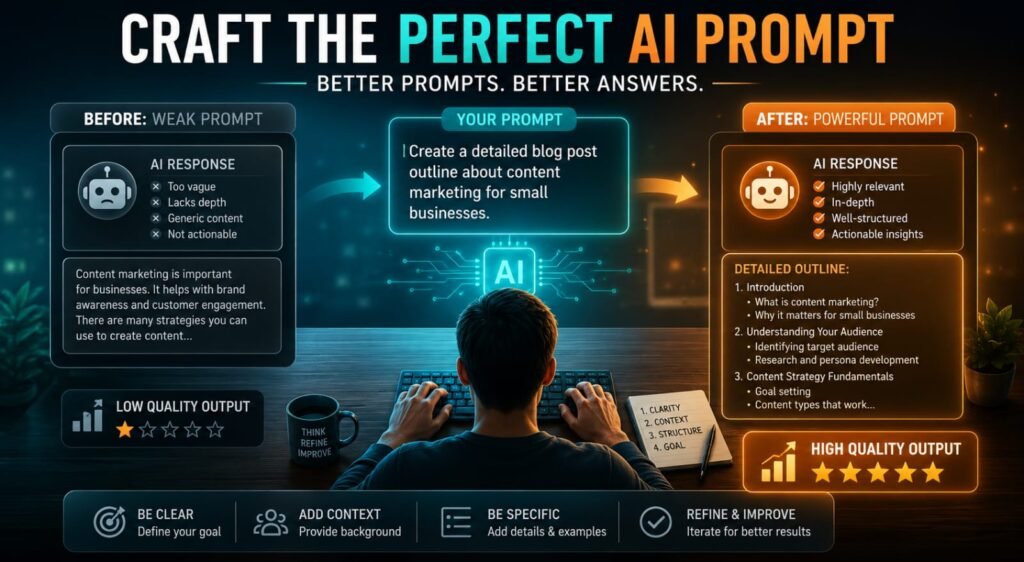
The difference between a frustrating AI experience and a genuinely transformative one almost always comes down to one thing: the quality of your prompts. Most people interact with AI tools at a fraction of their actual capability simply because they have not developed the skill of prompt writing. This complete guide takes you from the basics of what makes a good prompt through advanced techniques used by professional AI users, with concrete examples you can apply immediately.
Why Prompt Quality Matters So Much
AI language models respond to the information they are given. A vague, underspecified prompt forces the AI to make assumptions about what you actually need — and those assumptions may not match your intentions at all. A precisely written prompt that communicates context, specificity, format requirements, and constraints gives the AI everything it needs to produce exactly the output you are looking for.
The analogy that works best is this: asking an AI a poorly written prompt is like asking a new employee to “write something about our marketing” with no other context. Even a highly capable employee would produce something generic and likely not useful. Asking an AI “write a 500-word email campaign for our August back-to-school promotion targeting parents of elementary school children, emphasizing convenience and value, in a friendly and energetic tone” gives that same employee — or AI — everything needed to produce something genuinely useful.
For practical applications of better prompting in business contexts, see our guide on AI Automation for Small Business.
The Five Elements of an Effective AI Prompt
Every effective prompt contains some combination of five key elements, and the more of these elements you include, the more precisely targeted your results will be.
1. Role or context: Tell the AI who it is or what context it is operating in. “You are an experienced financial advisor” or “I am writing for an audience of small business owners with no technical background” both establish context that shapes everything the AI produces.
2. Specific task: Be precise about exactly what you want produced. “Write a blog post” is vague. “Write a 1200-word informational blog post” is specific. “Write a 1200-word informational blog post structured as a step-by-step guide” is even more precise.
3. Relevant background information: Provide any context the AI needs that it would not have by default. Your target audience, the purpose of the content, relevant facts or data to incorporate, tone requirements, and any specific points that must be covered.
4. Format requirements: Specify the structure and format of the output you need. Headers or no headers? Bullet points or prose? Word count? Number of examples? These specifications dramatically affect whether the output is immediately useful.
5. Constraints and requirements: Things the output must include, must avoid, or must accomplish. “Do not use technical jargon,” “Include at least three specific examples,” “End with a clear call to action” — these constraints shape the output toward your specific needs.
Before and After — Real Prompt Transformations
Before: “Write about debt payoff strategies.”
After: “Write a 1000-word guide for someone who has $15,000 in credit card debt across three cards and wants to pay it off in 3 years on a $500/month budget. Explain the debt avalanche method in simple terms, include a basic example calculation, and end with motivational advice about consistency.”
The “before” prompt produces a generic overview that could apply to anyone. The “after” prompt produces specific, actionable content for a defined situation.
Before: “Write a professional email.”
After: “Write a professional email to a client named Sarah who has not responded to my last three follow-up emails about a proposal I sent two weeks ago. The tone should be polite but gently persistent, acknowledge her likely busy schedule, reiterate the value of the proposal briefly, and suggest a specific 30-minute call time next Tuesday or Wednesday.”
The “before” version is impossible to fulfill helpfully. The “after” version gives Claude everything it needs to write something you could send immediately.
Advanced Prompting Techniques
Chain of thought prompting: For complex problems, ask the AI to think through the problem step by step before giving its final answer. Add “Think through this step by step” or “Explain your reasoning as you work through this” to the end of your prompt. This technique dramatically improves accuracy on reasoning-intensive tasks because it forces the AI to surface its reasoning process where errors can be caught.
Few-shot prompting: Provide examples of what you want before asking for the actual output. If you want Claude to write in a specific style, include two or three examples of that style before asking it to produce new content. This is particularly powerful for maintaining consistent brand voice, replicating specific formats, or producing output that matches unstated style preferences.
Role assignment: Assigning the AI a specific expert role can significantly improve the quality of responses in that domain. “You are an experienced emergency medicine physician” before a medical question, “You are a senior software engineer reviewing this code” before a code review request, or “You are a skilled copywriter for luxury brands” before a marketing task all prime the AI to approach the task from the right expert perspective.
Iterative refinement: Treat the first AI response as a draft rather than a final product. Follow up with specific refinement instructions: “Make this more conversational,” “Shorten the second paragraph significantly,” “Add three more specific examples,” or “Rewrite the conclusion to be more action-oriented.” This iterative approach consistently produces better results than trying to get everything perfect in a single prompt.
Structured output requests: When you need output in a specific format for further use — a spreadsheet, a numbered list, a table, JSON data — specify this explicitly. “Format your response as a numbered list with each item on a separate line” or “Present this as a table with columns for [X], [Y], and [Z]” gives you output that is immediately usable without reformatting.
Common Prompting Mistakes to Avoid
Being too vague about the audience. Every piece of content is written for someone — specify who. Forgetting to specify length or format, resulting in output that is the wrong length or structure for your needs. Asking multiple unrelated questions in one prompt, which typically produces unfocused answers to each. Not providing enough context about your specific situation, forcing the AI to give generic advice. Accepting the first response without iterating, when simple follow-up instructions could dramatically improve the output.
Prompts for the Most Common Business Tasks
For blog articles: “Write a [word count] word [SEO/informational/persuasive] article about [topic] for [audience description]. Include [number] subheadings, a meta description, and end with a call to action to [specific action].”
For emails: “Write a professional email to [recipient description] about [subject]. The tone should be [tone description]. Include [specific points]. The email should be [length] and end with [specific closing action].”
For social media: “Write [number] social media posts for [platform] about [topic] targeting [audience]. Each post should be under [character count] and include a question or call to action. Use a [tone] tone.”
For analysis: “Analyze [subject or text]. Consider [specific aspects to analyze]. Present your analysis in [format]. Conclude with [specific conclusions or recommendations].”
Building a Personal Prompt Library
As you develop prompts that consistently produce great results, save them in a personal prompt library. A simple document or note with your best-performing prompts organized by task type becomes an enormously valuable resource. You can refine these prompts over time and build a collection tailored specifically to your work and communication style.
For specific prompt templates for business writing, see our guide on the Best Free AI Tools for Small Business Owners which includes ready-to-use prompts for common business tasks.
Conclusion
Prompt engineering is a learnable skill that improves with deliberate practice. Start with the five-element framework, use the before-and-after examples as models, experiment with advanced techniques, and build your personal prompt library over time. The investment in developing this skill pays dividends across every AI tool you use and every task you apply them to. Combined with choosing the right AI for each task as described in our guide on ChatGPT vs Claude vs Gemini, strong prompting skills make you dramatically more productive with any AI assistant.