
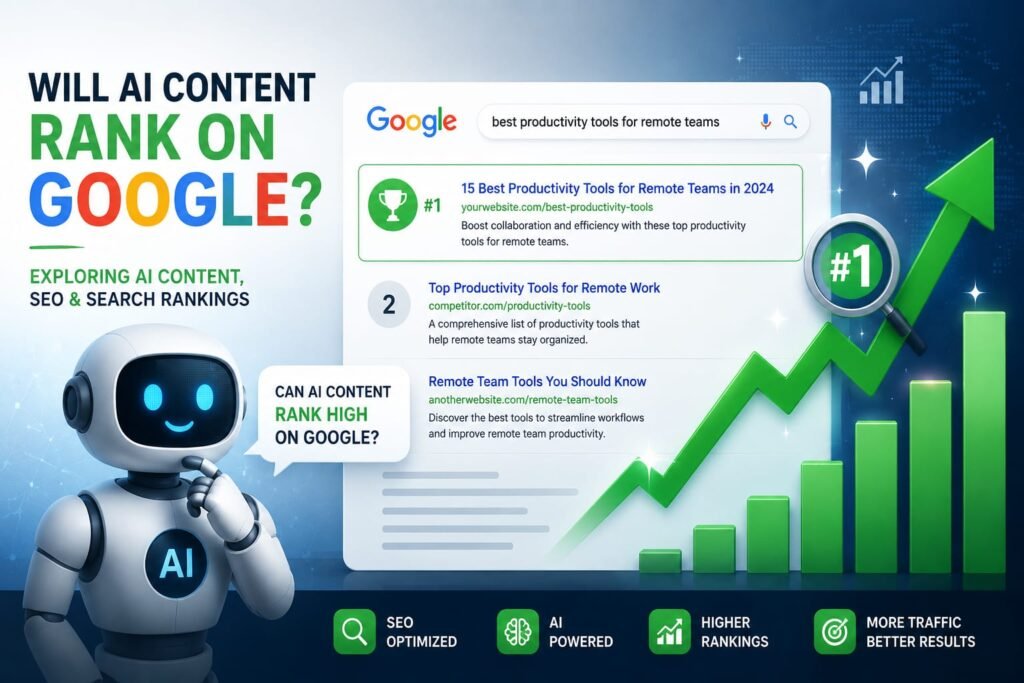
As AI content creation has exploded in popularity, the question every website owner and content marketer wants answered is simple: will Google penalize AI-generated content? The fear is understandable — significant SEO investments are on the line. The answer in 2026 is clear but frequently misunderstood, and getting it right makes the difference between a successful AI content strategy and wasted effort. This guide covers what Google actually says, what the data shows from real-world testing, and what you need to do to ensure your AI content performs well in search.
Google’s Official Position — The Definitive Statement
Google’s official position on AI content has been stated clearly and repeatedly: Google does not penalize content because it was created with AI assistance. What Google penalizes is low-quality content regardless of how it was produced. Google’s Search Quality Evaluator Guidelines and its Helpful Content system evaluate content on the basis of quality, helpfulness, and user experience — not the production method.
Google’s Search Liaison Danny Sullivan has addressed this directly: “Our focus is on the quality of content, not how it was produced. Content that is helpful, original, and created for people rather than to manipulate search rankings can rank well regardless of whether AI was involved in its creation.”
This is not a blanket endorsement of AI content — it is a clarification that the production method is not the variable Google measures. The variables Google measures are the qualities that have always determined ranking: expertise, authoritativeness, trustworthiness, and helpfulness. For techniques that improve AI output quality, see our guide on How to Write Effective AI Prompts.
The Helpful Content System — What It Actually Measures
Google’s Helpful Content system, which was significantly updated in 2024 and continues to evolve in 2026, is the most important algorithmic system to understand for anyone creating content at scale. This system attempts to algorithmically identify and demote content that feels created primarily to rank in search rather than to genuinely help readers.
The system evaluates signals including: whether content demonstrates genuine first-hand expertise and experience, whether it satisfies the searcher’s intent completely, whether it would leave a reader feeling satisfied or needing to search further, whether the site as a whole demonstrates expertise in its topic area, and whether the content provides meaningful original information or analysis beyond what is available elsewhere.
AI content can score well or poorly on all of these signals depending entirely on how it is created and edited. Thin AI content that simply regurgitates commonly available information without original insight will perform poorly. AI-assisted content that is thoroughly reviewed by a subject matter expert, enriched with genuine experience and perspective, and structured to comprehensively answer user questions will perform well.
E-E-A-T — The Framework That Determines Whether AI Content Ranks
Google’s E-E-A-T framework — Experience, Expertise, Authoritativeness, and Trustworthiness — is the evaluative lens through which all content is assessed. Understanding how AI content maps to each element clarifies what you need to do to ensure strong performance.
Experience: This element asks whether the content demonstrates first-hand experience with the topic. AI has no first-hand experience — it synthesizes information from its training data. This means AI content inherently lacks the experience signal unless a human editor adds genuine personal experience, specific case studies, real examples from the author’s work, or other experience-based content that AI cannot generate. Adding your own examples, results, and experiences to AI-drafted content directly addresses this weakness.
Expertise: AI can produce content that demonstrates surface-level expertise on almost any topic. For general informational content, this is often sufficient. For YMYL topics — Your Money or Your Life topics including health, finance, legal, and safety — Google applies stricter scrutiny and the expertise signal becomes critical. Having a qualified expert review, edit, and provide byline for AI-assisted content in these niches is strongly recommended.
Authoritativeness: This is about your site’s overall reputation and recognition in your field. AI content does not build authoritativeness on its own — that comes from quality backlinks, brand mentions, social signals, and recognition by other authorities in your niche. Your AI content strategy should be paired with active link building and brand development.
Trustworthiness: Trust is built through accuracy, transparency, and site signals like proper About pages, Contact information, Privacy Policy, author bios, and citations for factual claims. Ensuring your AI content is factually accurate through thorough review, adding source citations, and maintaining all the trust-building elements on your site addresses this element.
What Makes AI Content Rank Well — Practical Requirements
Based on Google’s guidelines and real-world testing, AI content that ranks well consistently demonstrates several qualities.
Comprehensive topic coverage: The content thoroughly answers the searcher’s question and related questions they might have, rather than covering only the surface-level aspects. AI is actually good at generating comprehensive outlines and ensuring topic coverage is complete.
Original analysis or perspective: The content adds something beyond what a searcher could find on the first ten results for their query. This almost always requires human contribution — an expert’s unique perspective, proprietary data, specific case studies, or analysis frameworks not found elsewhere.
Accurate information: All factual claims are accurate and where appropriate, supported by authoritative sources. AI can confidently produce incorrect information — thorough fact-checking is non-negotiable.
Appropriate depth for the topic: The content is as long as it needs to be to fully address the topic — not artificially padded to hit a word count, and not superficially brief when depth is needed.
Good user experience: The content is well-structured with appropriate headings, readable paragraph lengths, and a logical flow that helps readers find what they need quickly.
What Gets AI Content Penalized — Real Risks to Avoid
While the production method itself is not penalized, certain patterns associated with poor AI content implementation do result in ranking penalties or demotion.
Thin content at scale: Publishing hundreds of short, superficial AI-generated articles that provide minimal unique value is a classic pattern that triggers Google’s helpful content systems. Google can detect when a site has shifted to mass AI production with declining quality signals.
Factual errors: AI content that contains verifiable inaccuracies damages trust signals and can result in direct demotion for YMYL content. A single widely-shared fact-check of an inaccurate article can significantly damage a site’s authority.
No original value: Content that simply reorganizes information available on other sites without adding anything new provides no compelling reason for Google to rank it above the original sources.
Keyword stuffing and unnatural language: Some AI writing, particularly with poorly constructed prompts, produces unnaturally repetitive use of target keywords or stilted language patterns that read as artificial and may trigger spam filters.
The Practical AI Content SEO Workflow
The workflow that consistently produces AI content that ranks well follows this sequence. Research the topic thoroughly before prompting — understand what existing top-ranking content covers and what gaps exist. Write a detailed, specific prompt that includes your target keyword, audience, required depth, and any specific angles or information to include. Review the AI draft critically for factual accuracy, completeness, and quality. Add your own expertise, experience, and unique insights. Ensure the content comprehensively answers the target query and related questions. Add proper metadata, internal links, and source citations. Publish on a site with proper trust signals including author bios, About page, and contact information.
For the content creation workflow that incorporates all of these elements efficiently, see our guide on AI for Content Marketing.
Real-World Data — What Site Owners Are Experiencing
The real-world data from site owners using AI content in 2026 is consistent with Google’s stated position: quality matters more than production method. Sites that use AI as a productivity tool while maintaining genuine expertise and thorough human review report normal or improved rankings. Sites that switched to bulk AI production with minimal review experienced the helpful content penalties Google has been applying since 2023.
The dividing line is consistently the quality of human oversight. AI content with strong expert review performs as well as or better than equivalent human-written content. AI content published without meaningful review performs poorly. The AI is the writer; the human expert is the editor and quality controller.
Frequently Asked Questions
Does Google have an AI content detector? Google has not confirmed a specific AI content detector. Google measures quality signals, not production methods. However, thin AI content often fails quality signals that Google measures algorithmically.
Should I disclose when content is AI-assisted? Google does not require disclosure. However, for YMYL content and in some journalistic contexts, transparency about AI involvement is considered best practice and may build reader trust.
How much human editing is enough? There is no minimum threshold — the question is whether the final published content is genuinely helpful, accurate, and demonstrates real expertise. That bar varies by topic and niche.
Conclusion
AI content is not penalized by Google when it is genuinely helpful, accurate, demonstrates expertise, and provides original value. It is penalized when it is thin, inaccurate, or clearly produced to manipulate rankings rather than help readers. The practical implication is clear: use AI to accelerate content production while maintaining rigorous human review and expertise contribution. The production cost savings of AI are substantial — the quality bar remains exactly what it has always been. Read our guides on How to Write Effective AI Prompts and AI for Content Marketing to implement a compliant, effective AI content strategy.